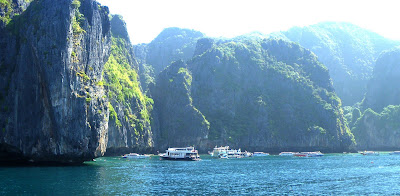
Saturday, May 30, 2009

Chiselled Rock

CHISELLED ROCK IS A TOWN IN JOHOR

I was born in Batu Pahat, also known as Bandar Penggaram, in Johor. Johor is southern most state in the Peninsular Malaysia; on the west by the Straits of Melaka; on the east by the South China Sea; and on the south by Singapore. It is about 3 hours drive from Kuala Lumpur.

The name Batu Pahat means 'chiselled rock' . The story goes, that the origin of this name can be traced back to a legend in the 15th century; when the invading Siamese troops were chiselling rocks at a rocky spot in the coastal village of Kampung Minyak Beku in hope to get fresh water during their retreat. They were being chased by the Melaka troops, led by Tun Perak, the famous Bendahara of the Malacca Empire. In fact, in around 1456, the Siamese army was led by Admiral Awi Di Chu camped in Batu Pahat before attacking Malacca.

Another legend has it that after capturing Melaka, the Portuguese built a fortress, 'A Famosa' of granite rocks taken from the mouth of Sungai Batu Pahat. The town acquired its name, which means "Chiselled Stone" from the quarries near the estuary.

Also renowned for its salted fish in the past, Batu Pahat was formerly known as Bandar Penggaram, which means town of salt-makers. In 1893, the present township was founded by Dato’ Bentara Luar, Salleh bin Perang, acting on the orders of the Sultan of Johor, Sultan Abu Bakar.

The ancient well can still be found in Minyak Beku, though little was done to maintain this ancient landmark which gave name to the town. For the town's centennial celebration in the early 90's, a quaint monument depicting a 'floating hand chiselling a rock' was built in the town square, which now has become the landmark of the town. There is also another square, known as Batu Bahat Walk, a popular place to spend the evenings with family and friends.

Batu Pahat is growing rapidly and has now developed to become the second major town in Johor, after Johor Bahru.

Batu Pahat district has 525 gazetted villages (kampung) and village-clusters (kampung rangkaian) where smaller villages were annexed to their bigger immediate neighbours for the purpose of administration. The villages are represented by Ketua Kampung (village heads), answering to the Penghulu (sub-district chief) administering the mukim. The mukim itself however is under the jurisdiction of the District Officer or Pegawai Daerah. The district office of Batu Pahat also has district engineers (Jurutera Daerah) to oversee all the sub-districts. Several kampungs have open their homes under the Homestay Programmes.

Apart from being known for its food and agricultural-based products, there are many small and medium industries such as textiles, garments and electronics, which has helped boost the development of Batu Pahat.

Talking about the variety of wild flora and fauna in Batu Pahat, it is almost every where, including my mother’s house. Our house is next to a school and part of our land has been taken away by the government, which is now a police station. Also, the areas in the neighbourhood have been developed into new housing areas. But not our small property is the only piece of land in the area covered by trees and more than 60 years old secondary forests.


I'd wake up to see a beautiful sun rise, birds, squirrels and a cup of tea while sitting at the veranda. We don’t have a big house but have leave it surrounded by trees, flowers and fauna, more than 20 species of birds, 3 species of monkeys (although we don’t really like them), monitor lizards, unwelcomed snakes, and other creepy creatures! The house has no fence, except for trees and bushes separate the properties from the neighbours and other developments. Since we have left the land covered by secondary forests and some fruits trees, we have no choice but to keep those animals as an extended family.

Because of the availability of land and open space, too, my mother has built a covered area, an extension from the back of the kitchen, an area for uninvited stray cats. My mother doesn’t like cat very much but people keep sending cats and kittens in front of our house when we are asleep. There are more than 20 cats, living at the 'back' of the house. There’s only one cage to keep the kittens until they are big enough to roam around. They would come back during meals but roam around or play in the grass or the ‘forest’ most of the time. So, we open part of the house to cats and make it an unregistered shelter home for the animals. We have also get a helper during the day to clean the cats' home.

Only one cat is allowed in to the house; and also because my mother has finally grown to like her. A female cat named Erra (because her of the ‘body’, long, thin and constantly clean herself like a beauty queen!). Erra has recently given birth to four kittens but somehow understood the rule that her kittens don’t live inside and will even help us keep the kittens out! Yes, Erra is a very smart cat. She ‘understands’ when we speak and even responds to it. The rest of the cats are given name after Malaysian singers, actors and mostly artistes of AF (reality show) so, I don’t know whether we like them or hate them for naming the stray cats after them! Even the monkeys and monitor lizards are named after AF past participants. Which make me wonder whether my family like the local reality shows or otherwise!

But I do know, it is always a joy to make a trip to Johor, especially the Chiselled Rock town.


There are so much to see in this small town called Batu Pahat, just don't know what else I'd discover in my next trip!

Jaina Ibrahim

Monday, April 27, 2009

Terengganu : Ganukita


Ganukita is what the local folks refer to the state of Terengganu; directly translated, meaning ‘Our Terengganu’. Terengganu overlooks the South China Sea, which makes driving through its towns and villages, which are mostly located on its coast, not only interesting but refreshing and breathtaking. Its 244 km coastline is endowed with numerous beaches of white sand, clear and water. From Kuala Lumpur, it took under 4 hours to make my first stop, in Kemanan. I won’t miss baked crabs whenever I arrived in Kemaman, or is it Chukai?

Since my destination was Perhentian Island, I've to stop in Kuala Terengganu for the rest of the afternoon, after driving for almost 6 hours; and decided to stay for the night in a small fishing town of Marang. Afternoon tea in the local coffee shop is ideal to observe what went on. Tea was sata and keropok lekor. Sata is an interesting blend of succulent boneless fish marinated in spices, wrapped in banana leaves and grilled over charcoal fire. Its sweet taste is tinged with the delicate aroma of the wrapping, making it a great appetizer and healthy snack. Keropok is another popular snack made of fish, ground to paste, mixed with, I think, tapioca flour; done either thin and crispy, or a bit soft and chewy called lekor. Both types are deep fried, served with its special chilli dip.

When the fishermen are not in the sea, the most popular afternoon activities in the villages would be socialising at the local coffee shops to either watch series of music videos of Indonesian dangdut music or playing a game of local chess. My translation of dangdut music is an Indian bollywood music improvised to local flavours, with lyrics either in Indonesian or Malaysian Language.

I’ve acquired another skill and good at it, after years of travelling alone i.e . being a good eavesdropper! Seated near a table of six men, pretending to read texts from the mobile, I heard discussions on what they were watching on tv, Indonesian music video. While watching mostly female singers’ video clips, discussions by the audience evolved from the singers’ life history, whom they are or were married to; and which part of Indonesia they live! Did I say that those dangdut singers are mostly female? They would sway their bodies; covered in tight fitting outfits, movements to me, appeared very provocative and sensual with several 180 degree turns, to show their backs to the audience, continued to shake and sway in what they called grudi while making a complete 360 degree turn. Such movements were not normally performed during public concerts as they appeared to be too sensual; but nothing will stop those coffee shop operators from playing those ‘sexy’ music videos.

While activities for children, will include playing on the beach or horseback riding, especially in Kuala Terengganu.
Breakfast in the East Coast for me has to be nasi dagang (translated as trader’s rice). This famous dish is synonymous with the East Coast and can be found almost everywhere in Terengganu. It is a mixture of normal with glutinous rice eaten with a variety of aromatic curries and dishes. The most popular accompaniment, which is also my favourite, is a spicy tuna curry and vegetable pickles.
It took less than 2 hours from Kuala Terengganu to Kuala Besut. There are several places for you to leave your cars under covered car parks which will charge you for RM7 a day near Kuala Besut Jetty. The only way to get to Perhentian Island is by sea, where boat services are available at the Jetty. Many tour operators are available at Kuala Besut to give information on how to get boat transfers, the accommodations and activities on the Island. Boat ride to the island takes about 1/2 hour, operating from 9.00a.m to 5.00p.m. Perhentian Island consists of Pulau Perhentian Besar (Big Island) and Pulau Perhentian Kecil (Small Island).
The name 'Perhentian' actually means 'stopover' resulting from fishermen using the islands as a resting point. The only place occupied by the local is a small community fishing village on Perhentian Kecil. The rest of the islands are uninhabited, with the exception of the resorts scattered around the fringing beaches. Inlands, the islands are covered in thick jungle.


My choice to stay for a week was the Watercolours Paradise Resort, having known Mike and his wife Nor, who are managing the resort. Actually they offer a choice of accommodation on both islands. Impiani Resort, located on the Perhentian Kecil and Watercolour (formerly known as Paradise) Resort, which is located on the Perhentian Besar. There are plenty of activities to keep you occupied during your stay. Snorkelling, jungle trekking and scuba diving are popular pastimes. It is even possible to catch a water taxi and laze on a deserted beach for the day. There are dive sites around both of these islands and other nearby small islands. The surrounding waters of Perhentian contain some of the best dive sites of peninsula Malaysia and the South China Sea. Diving is easy, with many dive sites (wreck dives and reef dives) to choose from. Because most of the dive sites are within the Marine Park, the corals are in good condition and the fish-life abundant. The diving season in Peninsula Malaysia runs from February to the end of November.


Terengganu's vast hinterland of virgin rainforests offers yet another point of interest to nature lovers. There is a multi-tiered waterfalls, the Chemerong Waterfall, nestled in a 130 million year old jungle, just 15 km away from 1,300 year old chengal tree, claimed to be the oldest in the world. There is Kenyir Lake, Sekayu Waterfall and part of the National Park and several limestone caves await my next visit to the state.

I wish to acknowledge my friend, Mike Soh, his wife Nor, Asiah and members of staff at the Watercolours Paradise Resort www.watercoloursworld.com for their kind hospitality and generosity, not forgetting Chef Soong for the lovely meals! Thank you all.

Jaina Ibrahim

Thursday, March 19, 2009

Discovering Marine Life

My first Attempt On Marine Photography


A little tale on how my quest for photography started ......

Photography has always been a hobby, next to travelling, obviously! I will always remember the joy of having my first camera in 1978, which was a Yashica Electro 35 (and still have it) and since, among friends, I was the only one who had a camera during those years, I was The photographer and with such encouragement, bought several guide books on how to improve my photography skills. Looking at the years, was just thinking, and wished I was in Sarawak taking pictures of this three years old girl who would probably was learning to speak or perhaps still running around naked!

Then, Richard Hardwick, my colleague at The British Council in 1984, suggested that I bought an ‘instant /automatic’ camera (though I’ve called idiotmatic) before leaving for a work trip to the U.K. So, I had a small and lighter piece, Canon AF3. Somehow, I felt the need to go back to a manually operated camera, so I’ve opted for a combination of Auto/Manual Canon EOS 630(but was rather disappointed with my choice) before leaving for another long trip to the North and Central Americas in early 1990s.

Then, came the era of digital camera and purchased a small Pentax . And as my computer skills improved, I bought a Mustek MDC, hmmm.. a multi-functional digital which I’ve also used as a webcam with my long distance friends. Sadly, accidently dropped it once and can’t be fixed, so visited Low Yat Plaza for the second time and bought a cheap USB Digital Webcam (called ‘Aloha’, seriously!), so, got digitalised with video conferencing, tilt- swivelling with spot lights clipped on the notebook, send video emails, recorded moving, and even still images. ‘Aloha’ continues to be my companion. There are also Nikon D50 and a small Canon Power Shot A430 when I am not online! Well, I am a poor and amateur photographer, so, what do you expect with my choice of cameras!

When I started diving last year, I’ve missed several photo opportunities simply because I didn’t have a camera case for underwater. Saw some really good underwater cameras but thought they were too costly, so, a novice diver only deserved a small Pentax Optio W60. It is good for indoors, outdoors, and, it is waterproof, coldproof (-10C/14F) and can go few meters underwater although there is no plan to photograph Antarctic or the Arctic, but, I am convinced that it is better than other lightweight underwater camera, including the Olympus series. Don’t believe me? Ask Roy of Tarita Photo at Sg Wang Plaza, Bukit Bintang.

While my thoughts were exploring the possibilities of what I might be able to see during my first visit to the famous Perhentian Island in a few days, hopefully, I’ve looked at my latest underwater photos and decided to post them after I’ve re-written certain parts of my travel journal.

Some Marine Life

Boxfish (Ostracion species) with Sergeant Major (Abudefduf sexfasciatus)
Starfish
Giant Clam (Tridacna species)


What you see here are my first encounter with coral reefs as a novice snorkeller. I’ve also discovered that to venture underwater in a coral reef is like immersing in a magical world. It is my hope that more people would do it, even if you are afraid of or not ‘in good terms’ with the sea! The vast numbers of species that coexist there gives me the feeling of being a 360 degree, three dimensional, technicolour cinema. No ecosystem on land can compete with the astonishing variety of shapes, sizes, colours and habits of the creatures that are associated with a coral reef ecosystem. (So, Helle, any second thought?)

Clown Anemonefish
(Amophiprion ocellaris)
Plumed Lionfish (Pterois volitan) also known as turkeyfish

I have also overcome my fear of deep water after discovered scuba diving. I hope to be a certified diver, soon, and after being convinced by a friend, Mike Soh, who operates resorts and dive centres at the Perhentian Island, off Terengganu.
I have been to Sipadan, Mabul, Kapalai and Semporna Marine Parks in Sabah and moved on from being an uninformed and distant intruder in the water, to be a sensible and sensitive observer. I felt being rewarded with increased knowledge of coral reef life and satisfaction with each dive.

Since I am no marine biologist, based on what I’ve read and learnt, I'd try to identify such organisms with common names and if I could, the scientific names for reasons that common names used arbitrarily from region to region. All I could do is to identify them from photographs, so it is not always possible to be absolute accurate and after all, I did say that I am a novice snorkeller/ diver and not a marine biologist!

Will try to post more marine life photos and tales in future, I hope.


Jaina, who has discovered that it's never too old to plunge into new hobby!