Thursday, March 19, 2009

Discovering Marine Life

My first Attempt On Marine Photography


A little tale on how my quest for photography started ......

Photography has always been a hobby, next to travelling, obviously! I will always remember the joy of having my first camera in 1978, which was a Yashica Electro 35 (and still have it) and since, among friends, I was the only one who had a camera during those years, I was The photographer and with such encouragement, bought several guide books on how to improve my photography skills. Looking at the years, was just thinking, and wished I was in Sarawak taking pictures of this three years old girl who would probably was learning to speak or perhaps still running around naked!

Then, Richard Hardwick, my colleague at The British Council in 1984, suggested that I bought an ‘instant /automatic’ camera (though I’ve called idiotmatic) before leaving for a work trip to the U.K. So, I had a small and lighter piece, Canon AF3. Somehow, I felt the need to go back to a manually operated camera, so I’ve opted for a combination of Auto/Manual Canon EOS 630(but was rather disappointed with my choice) before leaving for another long trip to the North and Central Americas in early 1990s.

Then, came the era of digital camera and purchased a small Pentax . And as my computer skills improved, I bought a Mustek MDC, hmmm.. a multi-functional digital which I’ve also used as a webcam with my long distance friends. Sadly, accidently dropped it once and can’t be fixed, so visited Low Yat Plaza for the second time and bought a cheap USB Digital Webcam (called ‘Aloha’, seriously!), so, got digitalised with video conferencing, tilt- swivelling with spot lights clipped on the notebook, send video emails, recorded moving, and even still images. ‘Aloha’ continues to be my companion. There are also Nikon D50 and a small Canon Power Shot A430 when I am not online! Well, I am a poor and amateur photographer, so, what do you expect with my choice of cameras!

When I started diving last year, I’ve missed several photo opportunities simply because I didn’t have a camera case for underwater. Saw some really good underwater cameras but thought they were too costly, so, a novice diver only deserved a small Pentax Optio W60. It is good for indoors, outdoors, and, it is waterproof, coldproof (-10C/14F) and can go few meters underwater although there is no plan to photograph Antarctic or the Arctic, but, I am convinced that it is better than other lightweight underwater camera, including the Olympus series. Don’t believe me? Ask Roy of Tarita Photo at Sg Wang Plaza, Bukit Bintang.

While my thoughts were exploring the possibilities of what I might be able to see during my first visit to the famous Perhentian Island in a few days, hopefully, I’ve looked at my latest underwater photos and decided to post them after I’ve re-written certain parts of my travel journal.

Some Marine Life

Boxfish (Ostracion species) with Sergeant Major (Abudefduf sexfasciatus)
Starfish
Giant Clam (Tridacna species)


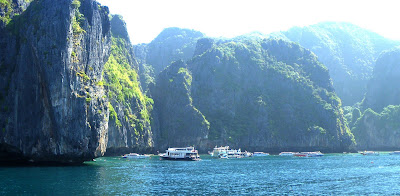
What you see here are my first encounter with coral reefs as a novice snorkeller. I’ve also discovered that to venture underwater in a coral reef is like immersing in a magical world. It is my hope that more people would do it, even if you are afraid of or not ‘in good terms’ with the sea! The vast numbers of species that coexist there gives me the feeling of being a 360 degree, three dimensional, technicolour cinema. No ecosystem on land can compete with the astonishing variety of shapes, sizes, colours and habits of the creatures that are associated with a coral reef ecosystem. (So, Helle, any second thought?)

Clown Anemonefish
(Amophiprion ocellaris)
Plumed Lionfish (Pterois volitan) also known as turkeyfish

I have also overcome my fear of deep water after discovered scuba diving. I hope to be a certified diver, soon, and after being convinced by a friend, Mike Soh, who operates resorts and dive centres at the Perhentian Island, off Terengganu.
I have been to Sipadan, Mabul, Kapalai and Semporna Marine Parks in Sabah and moved on from being an uninformed and distant intruder in the water, to be a sensible and sensitive observer. I felt being rewarded with increased knowledge of coral reef life and satisfaction with each dive.

Since I am no marine biologist, based on what I’ve read and learnt, I'd try to identify such organisms with common names and if I could, the scientific names for reasons that common names used arbitrarily from region to region. All I could do is to identify them from photographs, so it is not always possible to be absolute accurate and after all, I did say that I am a novice snorkeller/ diver and not a marine biologist!

Will try to post more marine life photos and tales in future, I hope.


Jaina, who has discovered that it's never too old to plunge into new hobby!

Monday, March 2, 2009

Tanjung Piai

TANJUNG PIAI, JOHOR

The Southern-Most Tip of Mainland Asia

The State of Johor lies at the southern end of Peninsula Malaysia. Johor in its early days, was known as Ujong Tanah (a Malay term meaning End of the Land). People said that the present name of Johor is reputed to have derived from the Arabic word Jauhar which means precious stone, so the Malay name Johor was coined as it sounded like Jauhar. Some travellers would refer Johor as the ‘southern gateway to Malaysia’.


Johor is also a land of multiple attractions, including recreational forests. Some well known forest parks including the Endau Rompin National Park near Mersing and the Gunung Ledang Park near Segamat. The south-west Pontian district is also blessed with a wide stretch of mangrove swamp along its coast and nearby islands.

Having visited numerous mangrove swamps in Johor coast lines, as early as 10 years old, I keep wanting to see more and continued to be fascinated by the uniqueness of mangrove swamps, its vegetation, birds and other living things found in the mangrove forests. I have visited several open and reserved mangrove forests designated areas in Malaysia, Thailand and Cambodia, and even when I was in Florida, USA, many years ago, I visited the Everglades and Key West.
More information on mangrove swamps and locations in Malaysia may be obtained from the Malaysian Nature Society (MNS) reports or its website.

The swamp is a home to different set of life forms, besides serves as the landing points to many migratory birds. To conserve them as wetlands sanctuary, most states in the country have ear-marked them for educational and recreational forest parks, including two in Pontian, namely the Tanjung Piai National Park and the Pulau Kukup National Park. Pulau Kukup National Parks is an island of 647ha of mangrove swamps and 800ha of mudflats, which was gazetted as a state park in 1997.

Both parks are easily accessible by road; travel along the coastal road of Pontian-Johor Bahru and the town Pontian Kechil is about 22km to Kampung Tanjung Piai. The Park is another 7km from the Kmpung. A short walk from Tanjung Piai Visitor’s Information Centre, will take you the monument, marking the location of the southern most tip of mainland Asia.

To get to Pulau Kukup Park, use the same route to Tanjung Piai. The jetty to the Park is located at Kukup Laut fishing town, which is 24km from Pontian Kechil town. These 2 parks have at least twenty mangrove species, and nine have been identified in the Tanjung Piai National Park. There are also birds, mammals, reptiles, amphibians and invertebrates found there. Shorebirds are easily spotted, especially during the migratory month of April. The common birds found are plover, whimbrel, sandpipers, terek, red shanks. There are also raptors like Brahming Kite and crested serpent eagle being spotted there.

Besides mangrove swamp, Kukup is an exit/entry point to Singapore and Indonesia (there is a Malaysia Immigration office there). Kukup, as a fishing village is also known for its sea foods. My visits to Kukup, as early as in 1970s were mostly family trips for its foods on our way to Singapore. Until today, Kukup is still popular for its sea foods restaurants and seafood-based products. Overnight visitors can choose to either stay at one of many hotels in Pontian, or the Kukup Golf & Resort. My recommendation is the Tanjung Riai Resort, not luxurious but it offers fishing facilities and good food.
Visitors to Tanjung Piai Park will also receive a certificate that says you have reached the southernmost tip of Mainland Asia. A 300m wooden walk path allows visitors to reach out to the sea and enjoy the feeling of reaching a world land mark.

Jaina
(Born in Batu Pahat, Johor)

Sunday, February 22, 2009

Culture Shock

What is Culture Shock?

Red flags to improve cultural awareness

Every book stores throughout the world would have the ‘culture shock’ series in its travel section. Those books intended to give us insights into culture of certain country or city; normally would carry titles like ‘Culture Shock in …..’ or ‘Living and Working in ……’.

My friend, Lynn Witham, an intercultural business consultant and trainer based in San Francisco wrote ‘Living and Working in Kuala Lumpur’ (2001) and said in her introduction that .. This book is designed to assist you in finding your way and feeling at home in this city of contrast. Whether you are a visitor or a resident, it can serve as an orientation prior to your arrival and as reference during your stay ….. I had the opportunity to read Lynn’s manuscript and travelled with her to some parts of the country while she was writing the book and also shared my views and experiences as a past director of an international / intercultural students exchange programme (AFS) in Malaysia. You can buy Lynn’s book online (Amazon). She has an earlier book, Malaysia – 'A Foreigner’s Guide' prior to 'Living & Working in Kuala Lumpur'.

Well, in addition to having assisted Lynn, worked as a past director of AFS and having had the exposure as a traveller to more than 20 countries, I wish to also share some tips, and hope that they will help, as you arrive in a new place: to identify new and unfamiliar culture as your warning signals or ‘red flags’. If we are able to identify them and remember that they are different (not strange), then we might reduce the amount of miscommunication and misunderstanding between oneself and people from another culture.

Judgements like “they are smelly” or “they are rude” or “they are disgusting” or “they are stupid” can create powerful barriers to good communications. But if we try to learn to use these subjective reactions as warning signals, or red flags, then will be aware of those differences; and that they could simply mean differences in the meaning of similar behaviour in one home country.

While having dinner in Florida a few years ago, I met a British couple who told me that they encountered a “strange” American couple whom they met while playing golf. The story was that this American couple never contacted them after saying “we will have dinner together”. They waited for that dinner but never heard from them again. So, I told them that they won’t call and that there would be no dinner.

Gesture has different meaning in different culture. I remember my first visit to London, where almost everyone in the office greeted with “how are you?” as soon as they saw me (I thought they were being nice to the only Malaysian in the office). While I was still thinking of the reply … they were gone! Soon, I have learnt that none of them were being rude when they asked and walked away at the same time. I have recognised the red flag, so, the next day, almost everyone at the British Council office in London received my “how are you?” before they could ask me; and without (me) having to look in their eyes! A difference in cultural meaning is not necessarily hazardous unless there is inappropriate expectation of something always pleasant. If we do, it may lead to disappointment.

But in a small town, Mosbach, in Germany, I had to say “Good Morning” so this small and extremely friendly community would know that I couldn’t speak German. That was as a result of my first attempt to greet the local folks earlier, which ended in an inappropriate application of the culturally determined rules because my attempt to greet in German at that point was assumed that I spoke the language and they started conversation while I couldn’t understand a word they said…

In Malaysia, there was a story of a Malay family who burped at the dinner table, while a young Australian girl, whom they were hosting was still “struggling” to remove bones from the tiny fish in her plate and trying to finish her rice with her fingers (hand). She complained to me about how “rude and gross” for burping. A few months later, I had lunch with the same girl and she burped in front me, but only smile and said “Alhamdullillah”. She has discovered a Malaysian way of thanking the host (me) and being grateful to the good food.

People in most cultures place a very strong emphasis on cleanliness. But misunderstandings arise because different groups have different definitions or customs about what constitutes the right sort and amount of cleanliness. When comes into contact with people who have different customs or rules about cleanliness, he or she may judge them to be “dirty” or “picky” depending on whether they are less or more attentive to a particular sort of cleanliness.

When one goes to a new culture, it may well happen that one gets the impression that the native people are dirty. Rather than stopping at this powerful negative observation, one should be able to use the reaction as a signal - a red flag that one may have hit upon an area where there are cultural differences in what is considered to be proper cleanliness.

Is it dirtier to spit and blow nose in the street or into a little piece of cloth that you keep in your pocket? Malaysians are not unclean because they do not use hot water to wash dishes and yes, some Americans do not bathe everyday.

How many of us have been asked if Malaysians wear jeans or if we still have houses on trees by our American friends. My sister, when she was in the USA, was tired of explaining where Malaysia is located and finally started telling them that Malaysia is near Texas. So, her friends said, “Ok”. Americans in general seem rather uninterested in what goes on outside their own country. Some of them have not been out their own State.

The issue of intimacy, especially sexual intimacy, is a difficult one that can lead to major misunderstanding between people of different cultures. A Malaysian met a French man during one of her trips and they became friends. When he invited her to a dinner at his apartment, she happily accepted it. When we met, she complained to me that she was expected to go to bed with him after the dinner and was upset about the incident.

When a host national gets angry, it is a good idea to start thinking. Many of us stop thinking and react emotionally when someone becomes angry at us. Seeing red flags is just the beginning. Even when a red flag lets one know that a cultural difference is operating, it may not be simple to bring that difference to light and to understand the differing patterns of behaviour that are involved. The process is like a crossword puzzle – the more parts one has answered, the easier it is to answer the remaining ones.

Well, I would use Malaysian delicacies as lessons to help foreign friends recognising Malaysian red flags when they arrived in Malaysia. My favourite item would include ABC (air batu campur or ice kacang). Corn and kidney beans in colourful syrup is shocking to them. Then, they were fish balls soup for a young American girl. After being told what they were, her reaction was, “I didn’t know fish have balls!!” My response to that was, “yes, they do and the size of the balls will depend on the size of the fish!” before burst out laughing with other fellow Malaysians.


How people react to such experience depends on many factors. But if we can manage to laugh with our visitors or hosts and to explain perfectly natural fact that certain things are unfamiliar, the experience can be a positive one. The visitor may be able to put him or herself in the host’s shoes, and to imagine what the situation must have looked like from their point of view.

Jaina Ibrahim

This section is dedicated to ex- AFS students who came to Malaysia; and Malaysians who participated in the same programme between 1986 ~ 1992 ... they were, and still are .. joy of my life.

Friday, February 13, 2009

Phnom Penh

Phnom Penh

For about USD15 a person, you can get on an air-conditioned bus from Siem Reap to Phnom Penh. It takes about 6 hours, with a stop for lunch. I had 4 days to visit the city, which was about right.

They said that the name Phnom Penh was based on a story about an old woman named Penh, who found four Buddha images that had come to rest on the banks of the Mekong. She housed them on a nearby hill, and the town that emerged around the hill came to be known as Phnom Penh – the Hill of Penh. But there was no legend neither there was a clue as to why Angkor was abandoned in the 1440s and Phnom Penh chosen as the site of the new Cambodian capital.

Phnom Penh sits at the confluence of the Mekong River, the Bassac River and the Tonle Sap River. Major boulevards run north-south, parallel to the banks of the Tonle Sap and Brassac rivers.

My first day, as usual, was to explore the city, and looked for location of restaurants nearby which hotel. Most hotels and many restaurants are located at the riverfront, and there is a jogging or walking track runs parallel to the river. There are also several Muslim eating places near the mosque area, besides quite a few Thai and authentic south and north Indian restaurants scattered all over the city.

Restaurants at the riverfront offer numerous choices, be it French, Italian and other western cuisines. Several good hotels are also situated here.

Must see places in Phnom Penh:

Tuol Sleng Genocide Museum


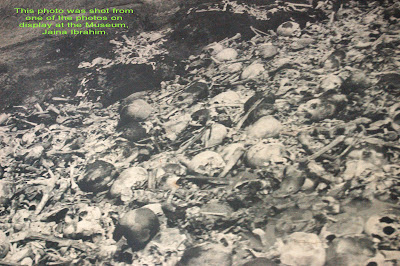
Prior to 1975, Tuol Sleng was a high school. When the Khmer Rouge came to power, it was converted into the Security Prison 21 (S-21) and interrogation facility. Inmates were systematically tortured, sometimes over a period of months, to get confessions, after which they were executed at the killing fields of Choeung Ek. S-21 “processed” over 17,000 people. When Phnom Penh was liberated by the Vietnamese army in early 1979, they found only seven prisoners alive at S-21. Fourteen others had been tortured to death as Vietnamese forces were closing in on the city. Photographs of their gruesome deaths are on display in the rooms where their decomposing corpses were found. Their graves are nearby in the courtyard. As now, I don’t know how many are still alive to testify on the case against Khmer Rouge. The unfinished investigation has taken years and the trial finally began on 16 February 2009, 30 years after the fall of the Communist Khmer Rouge. One of the former Khmer Rouge leaders called "Duch" was called on the first day of the trial. He has, apparently turned into a 'born again Christian' and had been behind bar since 1999. At least 4 more other most senior ex-Khmer Rouge members will be called to testify in this "crime against humanity" that has caused 1.7 million deaths. Just don't know when it will end. Keep reading...(this information is dated today, 17 February 2009)

The building now serves as a museum, a memorial and a testament to the madness and cruelty of the Khmer Rouge regime. Much has been left in the state it was when the Khmer Rouge abandoned it in January 1979. Like the Nazis, the Khmer Rouge was meticulous in keeping records of their barbarism. Each prisoner who passed through S-21 was photographed, sometimes before and after tortured. The museum displays include room after room in which such photographs of men, women and children cover the walls from floor to ceiling; virtually all the people pictured were later killed. You can tell in what year picture was taken by the style of number board that appears on the prisoner’s chest. Several foreigners from Australia, France and the USA were held here before being murdered. The prison kept extensive records, leaving thousands of photos of their victims, many of which are on display.


As the Khmer Rouge ‘revolution’ reached ever greater heights of insanity, it began devouring its own children. Generations of torturers and executioners who worked here killed their predecessors and were in turn killed by those who took their places. During the first part of 1977, S-21 claimed an average of 100 victims a day.

Paintings of torture to the prison by Vann Nath, a survivor of Tuol Sleng, are also exhibited. The museum’s famous but controversial skull map has been dismantled and no longer on display.

A visit to Tuol Sleng could be a depressing experience. There is something about the sheer ordinariness of the place that make it even more horrific – the urban setting, the plain school buildings, the grassy playing area where several children kick around a ball, rusted bed, instruments of torture and wall after wall of harrowing black and white portraits conjure up images of humanity at its worst. Tuol Sleng is not likely for the squeamish.

Choeung Ek Memorial (The Killing Fields)

From April 17, 1975 until January 7, 1979, the ultra-Communist Khmer Rouge regime led by Pol Pot, controlled the whole of Cambodia. Under the Khmer Rouge, the country was known as “Democratic Kampuchea.” During that short regime, between one million and two and a half million Cambodians were perished, including educated and high ranking government officials prior to the regime. Some were killed outright, others dying of diseases, malnutrition, neglect and ill-treatments. Many of the dead ended up in a various “killing fields” that can be found scattered across the country. The killing fields were essentially ad hoc places of execution and dumping grounds for dead bodies. The memorial at Choeung Ek, located just outside Phnom Penh was longan orchard and a Chinese cemetery prior to 1975. During the Khmer Rouge regime, it became one of the brutal executions of more than 17,000 men, women, and children, most of whom first suffered through interrogation, torture and deprivation in the in the S-21 Prison (Tu0l Sleng) in Phnom Penh.


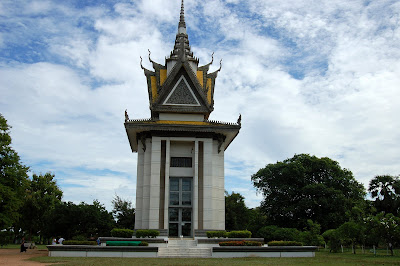
The remains of 8,985 people, many of whom were bound and blindfolded, were exhumed in 1980 from mass graves, and apparently, 43 of the 129 communal graves here have been left untouched. Fragments of human bone and bits of cloth are scattered around the disinterred pits. Over 8,000 skulls, arranged by sex and age, are visible behind the clear glass panels of the Memorial Stupa, which was erected in 1988.

The Killing Fields of Choeung Ek is about a 30 minutes drive from the centre of Phnom Penh. If you do visit both Choeung Ek and Tuol Sleng, you would be able to understand a bit more on what had taken place during that period.


Other places to visit include:

The distinctive rust-red National Museum next to the Royal Palace was dedicated by King Sisowath in 1920. Over 5,000 objects are on display including Angkorian era statues, lingas and other artifacts. Make more sense to visit the Museum after you have visited Angkor.

A stroll along the park lined riverfront is a must, and stop at your choice of pubs or restaurants. Stay at one of the hotels situated in the area will be a good idea, too.

Both the Russian Market and Old Market are worth exploring but eating there, like many markets in South East Asia, would only be for the adventurous eaters or if you are familiar with the local hawkers' food

Wednesday, February 11, 2009

The Great Lake of Cambodia

Tonle Sap (The Great Lake)


The Tonle Sap Lake is about 30 minutes south of Siem Reap. It is said to be the world’s largest freshwater lake. It’s approximately 2500 square km but during the wet season, it swells to 12,000 square km. Floating fishing village dot the semi-submerged forest that lines the flood plane rim of the lake, offering a unique ecosystem with birds and other wildlife.

Charter a boat for the trip is about USD20 for 1-2hr trip but could cost you cheaper if you join group. A variety of tours are also offered in the area, including birding, and Tonle Sap is a home to 120 bird species. Alternatively, there is a Sampan Boat Tour which offers exursions with overnights on board the boat.